

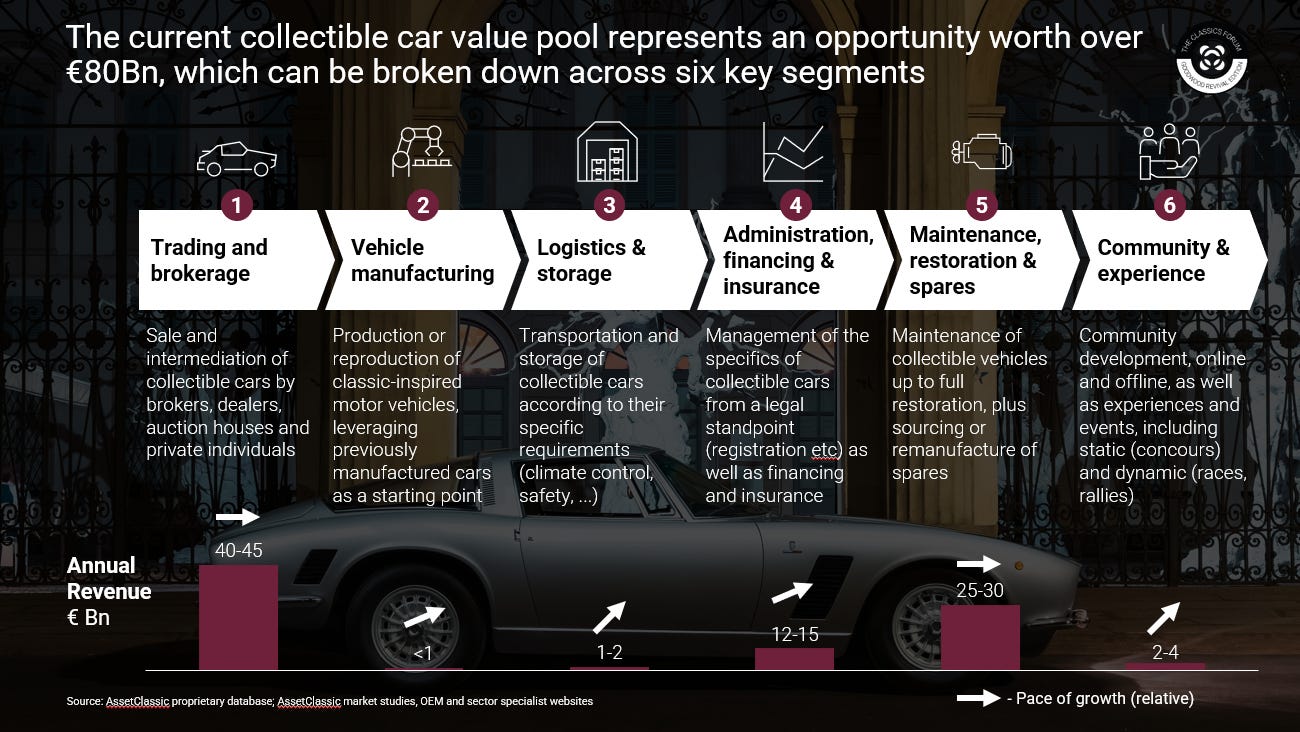
In Part 1: From Passion to Asset Class – Framing the Collectible Car Sector, we established the scale and structure of the €800 billion collectible car ecosystem and introduced its six core value-chain pillars.
In Part 2: The Marketplace of Passion – Inside Collectible Car Trading & Brokerage, we examined the €40–45 billion trading engine that drives liquidity, price discovery, and market transparency.
In Part 3: The Invisible Infrastructure – Logistics & Storage in the Collectible Car Economy, we explored how transport, climate-controlled custody, and the emerging “Storage-as-a-Hub” model protect value and underpin the ownership experience.
This fourth article turns to the segment that holds the asset class together behind the scenes: Administration, Financing & Insurance.
With an estimated €12–15 billion in annual revenue, this is one of the larger pillars of the value chain – yet much of it is invisible to the casual observer. It is the legal, financial, and risk-management layer that turns a beautiful object into a properly owned, properly protected, and properly transferable asset. Where trading is the market’s most visible act and storage its physical backbone, administration, financing, and insurance are its quiet architecture: rarely celebrated, but essential to the integrity of every transaction.
The perspectives presented here are grounded in AssetClassic’s research and discussions at The Classics Forum 2025, held at Goodwood House during the Goodwood Revival – a convening of industry leaders focused on the future of the collectible car sector (www.theclassicsforum.com).
Market Size and Structure
Administration, financing, and insurance together generate approximately €12–15 billion in annual revenue, broken down across three distinct sub-segments:
Insurance – approximately €9–11 billion, the dominant share of the pillar.
Financing – approximately €2.5–3.5 billion.
Administration – approximately €0.2–0.4 billion.
Each plays a different role. At its essence, this pillar manages the specifics of collectible cars from a legal standpoint – registration and the rest – as well as financing and insurance. Together they convert ownership from an act of passion into a managed financial position.
Insurance: The Specialist’s Domain
Insurance is the largest component of the segment, and it is also the most mature. The landscape is a mix of large traditional companies and specialized players of different sizes.
A defining feature is consolidation behind the scenes: several regional niche leaders are backed or owned by larger players – for example, Hagerty’s relationship with State Farm, or Footman James with Aon. The specialist brand stays close to the enthusiast; the balance sheet sits with a larger institution.
What distinguishes the most successful players is that they do not simply underwrite risk. Focused players extract more value from clients and retain relationships through enthusiast offerings – community and events, insight, and partnerships. In other words, insurance in this sector is increasingly a relationship business as much as a risk business, with the policy serving as the entry point into a broader engagement with the collector.
Financing: Underserved and Under-Penetrated
If insurance is the mature corner of the segment, financing is the frontier.
The collectible car market is, today, underserved by traditional providers – banks and leasing companies have largely stayed on the sidelines. Into that gap have stepped niche players offering options at shorter terms and higher rates than are available for new cars, reflecting both the specialist underwriting involved and the relative immaturity of the market.
The headline, however, is the upside. There is large growth potential if collectible car financing scales toward the level of new car financing – potentially 2–3x its current size in the near term.
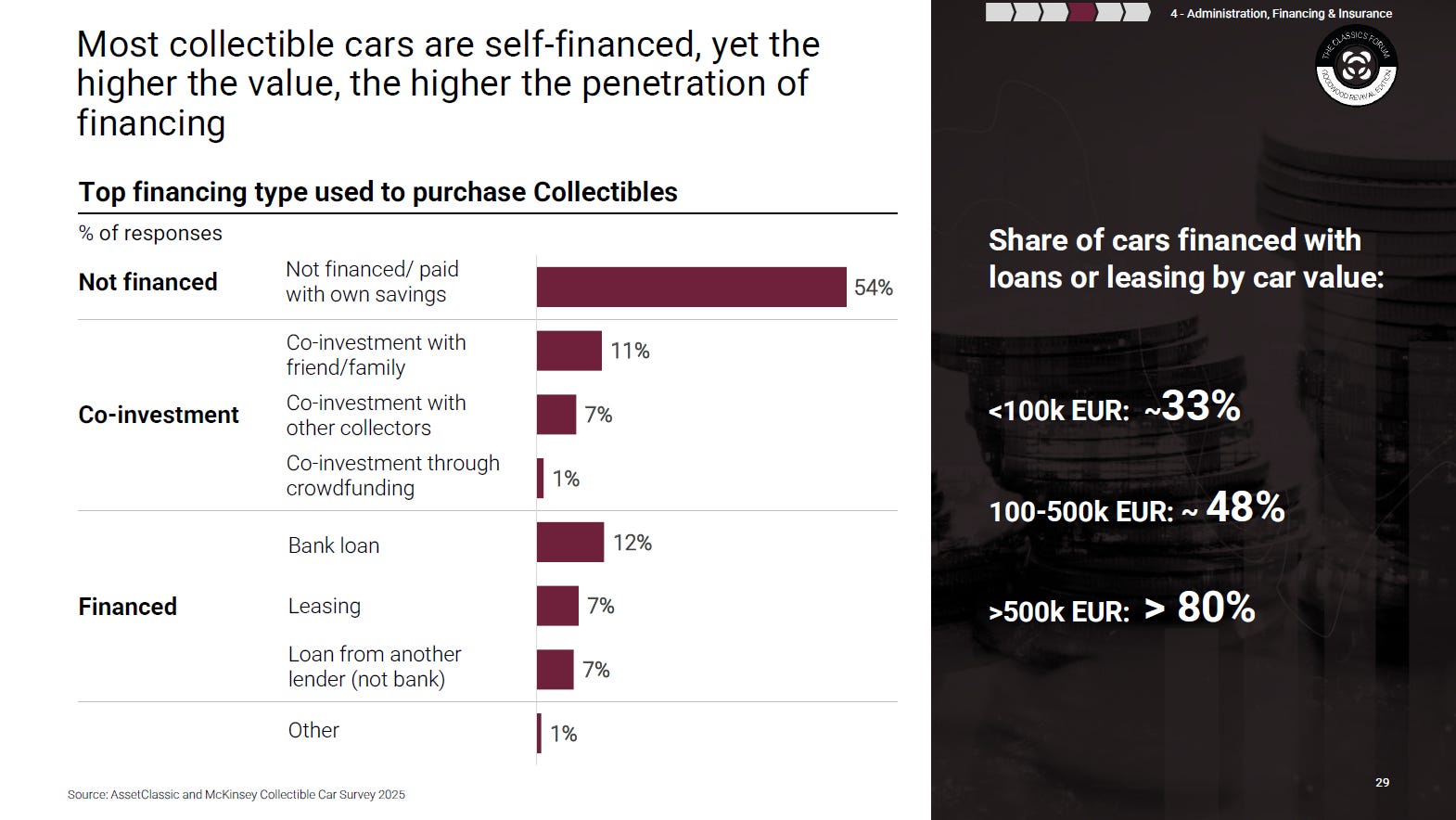
The survey data explains why the runway is so long. Most collectible cars are self-financed: roughly 54% of buyers pay with their own savings, with no external financing at all
The most revealing pattern is that financing penetration rises sharply with value. The share of cars financed with loans or leasing climbs from ~33% for cars under €100,000, to ~48% in the €100,000–500,000 band, to more than 80% for cars above €500,000. At the top of the market, financing is not the exception – it is the norm. This is the clearest signal of where the financing opportunity concentrates.
Administration: Small in Revenue, Large in Friction
Administration is the smallest sub-segment by revenue (€0.2–0.4 billion), but its importance is disproportionate to its size, because it is where much of the market’s friction lives.
There is a genuinely positive structural tailwind: growing recognition of the cultural value of collectibles is leading to lower urban access restrictions and reductions in taxes and congestion charges in some jurisdictions. Heritage status, increasingly, comes with practical privileges.
But the countervailing force is significant. National and international uncertainty drives major complexity and pain points for collectors – the cross-border, multi-jurisdiction nature of the modern market means that registration, compliance, and transfer can be genuinely difficult. Administration is small as a revenue pool precisely because it is fragmented and bespoke; it is large as a problem precisely for the same reason.
What Sector Actors Say Is Holding the Sector Back
At The Classics Forum 2025, we asked participants to identify the biggest administrative pain point or growth restriction facing the sector today. The results map almost perfectly onto the three sub-segments above:
Import/export duties and taxes: 36% – the single largest constraint, and squarely an administration issue.
Collectible car financing availability and cost: 29% – confirming that the financing gap is felt acutely by participants.
Classic car insurance cost and actual coverage: 20%.
Cost and capacity/availability for OEM certifications: 15%.
The message is striking. The top two pain points – duties/taxes and financing – are precisely the areas where the segment is least developed. The friction collectors feel is the mirror image of the opportunity for those willing to professionalize it.
Trends and Opportunities
Several developments are reshaping the administration, financing, and insurance landscape, and are likely to continue doing so in the coming years.
Rising insurance costs are a global headwind. Standard auto insurance rates have surged – U.S. CPI data shows auto insurance up roughly 51% over the past three years, around six times the rate of overall inflation. Classic car owners, who typically drive cautiously and maintain their vehicles well, have nonetheless been swept up in these broad increases – and, arguably, disproportionately so.
Tailored policies are becoming the standard. Owners are willing to pay for specialty coverage that reflects their vehicles’ appreciating values and unique risks, and insurers have responded with ”agreed value” policies and other custom features built specifically for collectibles.
Private banks – and specialist ecosystems – are entering the financing conversation. There is rising involvement from private banks, both as a means of furthering client relationships through events and as a route to co-investing in or financing the purchase of collectible cars and collections – exemplified by partnerships such as RM Sotheby’s with Premier Financial Services. The same logic is now visible in integrated specialist offerings: Hagerty, for instance, has brought together collector insurance, the auction and lending expertise of Broad Arrow Capital, and the lease-to-own solutions of Putnam Leasing into a single ecosystem – allowing a collector to insure, finance, and acquire a car through one connected set of providers. It is a clear signal of where the segment is heading: away from fragmented, transactional services and toward joined-up platforms built around the collector.
Collateralization is on the rise. Collectors are increasingly using their cars as collateral for loans – often, notably, to finance the purchase of other collectible cars. The asset is no longer just something to own; it is something to borrow against.
Certifications are becoming a transaction prerequisite. The market is starting to treat OEM certifications as a requirement for collectible transactions, and is discounting cars without them. As authentication moves from “nice to have” to “must have,” it links this pillar directly to value preservation – and to the cost and capacity concerns collectors flagged in our poll. We will cover OEM certifications in much greater detail in a follow-up post in the coming weeks.
Outlook: Professionalization as the Prize
Administration, financing, and insurance may operate in the background, but they are where the collectible car market most clearly demonstrates its transition from passion to asset class.
The pattern across all three sub-segments is consistent. Insurance has matured into a specialist, relationship-driven business. Financing remains underdeveloped relative to its potential, with penetration concentrated at the top of the market and substantial headroom to grow. Administration is small in revenue but heavy in friction, weighed down by cross-border complexity even as cultural recognition delivers offsetting benefits.
In each case, the opportunity is the same: professionalization. Clearer certification standards, more accessible and competitively priced financing, tailored insurance products, and reduced cross-border friction would not only relieve the pain points collectors identified – they would unlock the next phase of the asset class’s growth.
The value-chain schematic introduced in Part 1 once again serves as our roadmap. Having explored trading and brokerage, then logistics and storage, and now administration, financing, and insurance, we continue to see how each pillar reinforces the others.
Next in the series, we will turn to Maintenance, Restoration & Spares – the second-largest part of the value chain – where craft, scarcity, and the growing need for professionalization meet.
This article is part of an AssetClassic thought-leadership series based on insights developed for The Classics Forum 2025, held at Goodwood House during the Goodwood Revival. The series explores each segment of the collectible-car value chain: from trading and brokerage to restoration, manufacturing, and heritage programs, through the lens of data, market structure, and cultural evolution.