

Introduction
Collectible cars are a €800 billion global asset class and trading and brokerage is its financial engine. Every restoration, rally, and concours ultimately depends on one essential act: the exchange of ownership.
This second article in the AssetClassic Collectible Car Sector Series builds on our overview from Post 1 and draws from the insights presented at The Classics Forum 2025 at Goodwood House during the Goodwood Revival (www.theclassicsforum.com). It examines how cars move through the market - across dealers, brokers, auctions, and online platforms - and how digitalization, transparency, and generational change are reshaping the sector’s largest and most visible segment.

Scale and Significance
Trading and brokerage represents €40–45 billion in annual revenue, making it the single largest part of the collectible car value chain.
While auction results dominate headlines, they reflect only a fraction of the market. In fact, the majority of transactions, often half or more, occur in the private sphere, quietly negotiated between individuals, collectors, and trusted intermediaries.
This duality defines the sector: a highly visible tip of the iceberg supported by a vast, opaque base of private trades. Transparency and liquidity are improving, but the market remains relationship-driven, dependent on reputation, trust, and increasingly, data.
A Complex Market Structure
The trading ecosystem is diverse, ranging from global dealership networks to single-marque specialists and online platforms.
Dealers and Brokers. Established dealers operate at every level of specialization: from mainstream premium brands to ultra-niche race cars. Independent brokers often act as matchmakers for high-value private sales, leveraging personal networks rather than public listings.
Auction Houses. Traditional auction houses (e.g., RM Sotheby’s, Bonhams, Gooding & Co.) remain influential market markers, while online-first platforms such as Bring a Trailer and Collecting Cars have democratized access and transparency.
Platforms. Digital platforms have potential to become crucial discovery tools, aggregating listings and enabling remote due diligence.
Private Individuals. Peer-to-peer transactions, facilitated by collectors, agents, or online communities, still account for up to 50 % of the market’s total value.
At one end of the spectrum are large global players handling hundreds of cars yearly; at the other are small, highly specialized dealers focusing on a single marque or period. Between them sits a growing layer of hybrid actors - collectors who occasionally broker cars within their network or collaborate with digital platforms to reach a global audience.
Auctions: Visible but Limited
Auctions remain the market’s most visible and measurable component. They provide valuable price benchmarks and a sense of liquidity, but account for only 15–30 % of total transactions.
Over the past decade, the average auction sale price has remained relatively stable, around €60 000, despite the proliferation of online sales. Traditional auction houses maintain higher average prices (~€85,000, but with large variance between houses) compared with online platforms (~€50,000).
Online auctions have, however, revolutionized accessibility. They attract younger buyers and enable global participation in real time. The model’s success lies in transparency: high-quality imagery, open comment threads, and verified transaction histories have brought trust to a market once criticized for opacity.
Beyond the Gavel: Private and Public Listings
While auctions draw attention, public listings - from dealer websites to specialist classifieds - represent 30–40 % of the market. They cater to both private collectors and professional investors who prefer negotiated sales over competitive bidding.
Meanwhile, individual-to-individual sales, including discreet off-market deals, make up roughly half of all transactions. These are often facilitated by trusted intermediaries or agents and are essential to understanding true market liquidity. Their opacity remains one of the sector’s biggest analytical challenges; it can be understood only through close participation and strong industry networks.
Generational Shifts and Demand Patterns
One of the most telling dynamics in today’s market is generational. Cars from the 1980s, 1990s, and early 2000s have experienced the strongest price growth over the prior 3 years (a trend that continues in 2025), reflecting the tastes of younger collectors.
While pre-1970 icons still dominate the highest-value auctions, demand is broadening. Modern classics (Ferrari F40s, Porsche 993s, or rally-bred icons from Subaru) are drawing attention from a demographic that values usability and nostalgia in equal measure.
This shift has two implications:
Broader participation. The entry point for collectors has lowered, attracting new buyers who engage digitally first.
Changing liquidity patterns. Newer cars trade more frequently, increasing velocity within mid-market segments.
The Rise of Digital Platforms
Digital transformation is perhaps the single most powerful catalyst reshaping trading and brokerage.
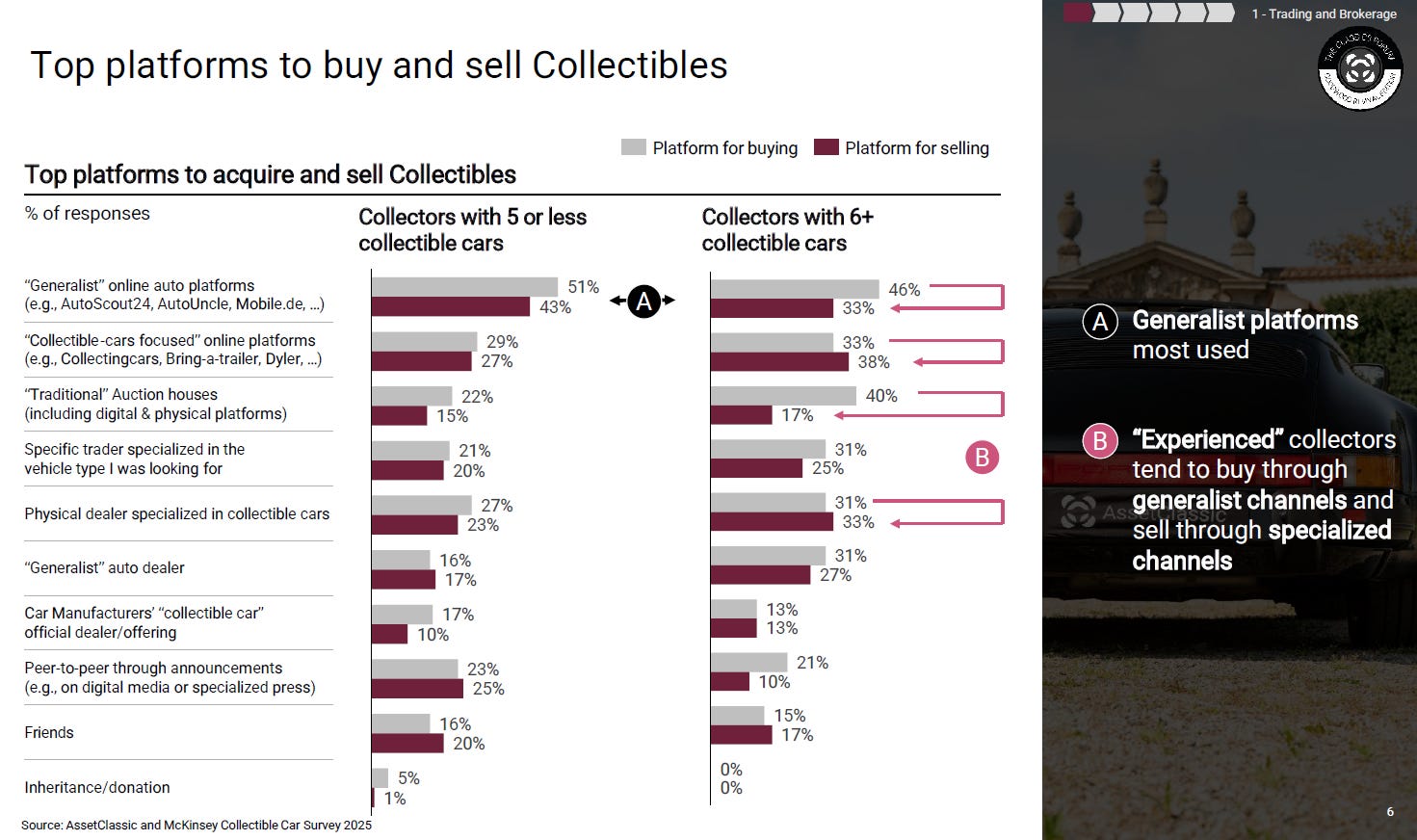
According to the AssetClassic & McKinsey Collectible Car Survey 2025, generalist platforms such as AutoScout24 and Mobile.de remain the most used entry points for acquiring cars, but specialist marketplaces (e.g., Bring a Trailer, Collecting Cars, Dyler) are rapidly gaining traction.
Interestingly, the survey shows that experienced collectors (six or more cars) tend to buy through generalist channels, where selection is broader, but sell through specialist channels, where community validation and transparency support higher realized prices.
This behavioral asymmetry highlights a fundamental truth of the modern market: trust is now crowdsourced.
Ratings, comment threads, and community feedback increasingly shape perceptions of authenticity and value. For sellers, reputation management has become a critical asset.
Liquidity and Transparency: The Market’s New Frontier
At The Classics Forum 2025, we asked participants which factors would most improve liquidity in the collectible car market. The top 3 results of our live poll were clear:
60 % identified improved valuation transparency as the top lever.
49 % pointed to new technology enabling better digital inspections and remote purchasing.
33 % highlighted reduced cross-border transaction costs.
These findings suggest that while the market is maturing, structural inefficiencies persist. Prices can vary dramatically for similar cars across regions, and transaction friction (logistics, taxes, regulatory hurdles) still limits liquidity.
Technological advances promise solutions: remote inspections via 3D imaging, blockchain-based provenance records, and integrated cross-border payment systems could collectively reduce friction and boost confidence.
Trends and Opportunities in 2025
Several major trends are reshaping the trading and brokerage landscape in 2025, and will likely continue doing so through the next years.
Tariffs and regulations continue to influence cross-border transactions, particularly between Europe (including United Kingdom) and the U.S., slowing trade for contemporary classics and older vehicles.
The online auction boom, once the engine of digital growth, appears to be stabilizing, suggesting that the sector may be reaching a saturation point. The next wave of expansion will depend on new engagement formats, enhanced verification standards, and integration with financing and logistics.
Meanwhile, the highly visible sale of entire collections, such as the Bernie Ecclestone and Mansour collections, shows a shift toward consolidated, brand-managed storytelling rather than fragmented sales.
Transparency is also accelerating: the growing availability of transaction data and car histories from platforms such as Hagerty, Classic.com, and AssetClassic’s own Carburate are enabling more data-driven pricing and buyer confidence.
Finally, the rise of direct trading platforms such as Carsup, ParNexus, and Car Collector signals a move toward disintermediation, connecting buyers and sellers directly at lower transaction costs while redefining the traditional dealer’s role in the value chain.
Parallels with Other Asset Classes
The evolution of car trading mirrors patterns seen in other collectible sectors. For example, the art market’s digital expansion created a new global buyer base.
Cars now stand at a comparable inflection point. Auction catalogs and dealer inventories are accessible worldwide, valuations are increasingly data-driven, and cross-border trade is more feasible than ever. For participants, this convergence of passion and professionalism offers unprecedented opportunity.
Outlook: The Marketplace Reimagined
As trading and brokerage mature, the next phase will be defined by three forces:
Digital integration. The line between physical and digital markets will blur as hybrid auctions, big data-powered valuations, and virtual showrooms become standard.
Professionalization. Expect the rise of certified intermediaries and data-verified transaction platforms, echoing developments in fine-art brokerage.
Community. Engagement will extend beyond the transaction. Buyers and sellers increasingly seek connection - whether through digital forums, private clubs, or events that celebrate heritage.
For many, the appeal of classic cars lies precisely in this blend of passion and purpose: an investment that can be seen, heard, and driven.
Conclusion
Trading and brokerage sit at the core of the collectible car economy. It is where passion meets price discovery, and where culture translates into capital.
As the sector continues to evolve, liquidity, transparency, and professionalism will determine its trajectory.
The value-chain schematic introduced in Post 1 serves again as our roadmap. Trading and brokerage, the first of its six pillars, is both the most mature and the most dynamic. In the coming articles, we will move along the chain to explore Vehicle Manufacturing, where the boundaries between heritage and innovation blur through continuation models, restomods, and modern reinterpretations.
For those who joined us at The Classics Forum 2025, this ongoing analysis continues the conversation that began at Goodwood: how to build the infrastructure, standards, and insight necessary for a more connected, transparent, and investable collectible-car market.
This article is part of an AssetClassic thought-leadership series based on insights developed for The Classics Forum 2025, held at Goodwood House during the Goodwood Revival. The series explores each segment of the collectible-car value chain: from trading and brokerage to restoration, manufacturing, and heritage programs, through the lens of data, market structure, and cultural evolution.