We have recently seen economic disruptors aplenty – a pandemic, a major war and a deepening financial crisis. Classic cars, seen as an asset class, have outperformed the broader markets since 2000, especially in the periods of uncertainty, with an average annual growth rate of 13% and almost $40 bn worth of collectible cars trading hands each year. Investing in the collectible car market has long attracted enthusiasts and investors, as it combines the appeal of owning a vintage vehicle with the perspective of financial rewards. However, hidden beneath timeless bodyworks and roaring engines lie multiple challenges which could mislead inexperienced purchasers.
Successful and sustained investment in classic cars demands deep market understanding, extensive networks, and scale to capitalize on efficiency. In this article, we will explore the challenges across these three broad areas required to successfully invest in collectible vehicles, as well as offer some insight on overcoming them.
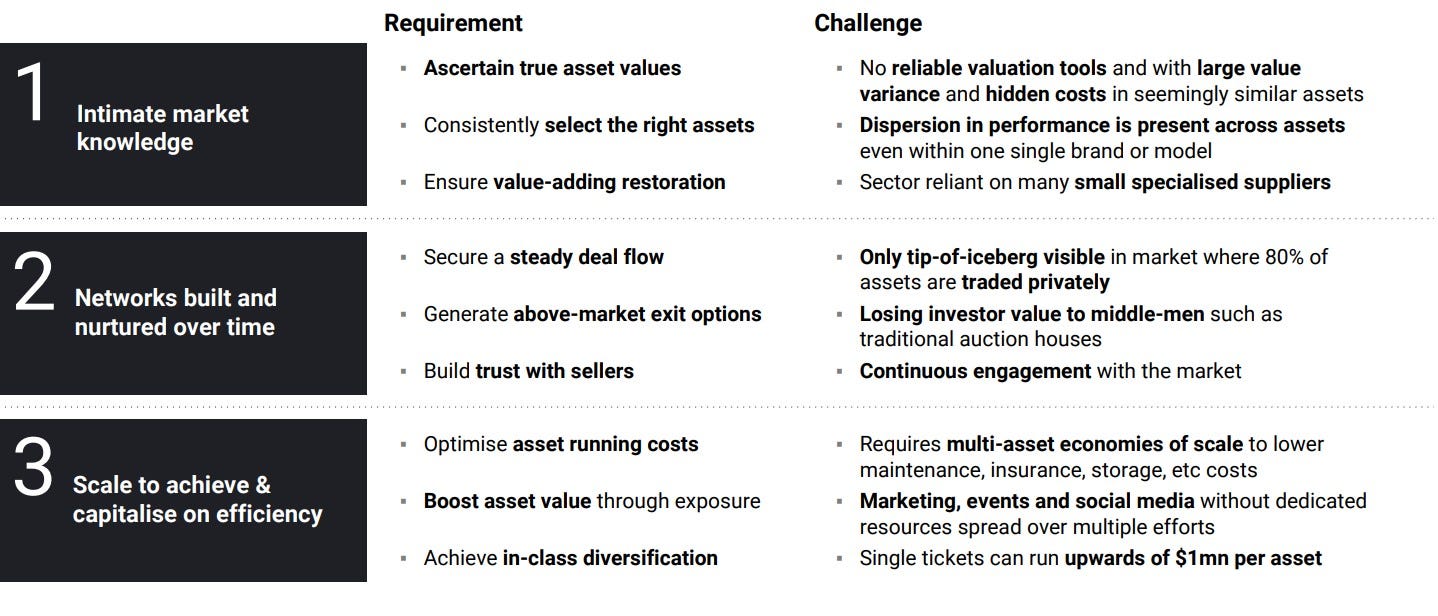
1. Intimate knowledge is key - and a lot of effort goes into developing it
Navigating the world of classic car investments requires a deep and sound understanding of the market. This means being able to identify the real intrinsic value of an asset. The lack of a standard and commonly-accepted tool to reliably determine the value of a vintage vehicle makes this a difficult task. Standardized pricing models, especially multiple or cash flow-based approaches typically used when dealing with traditional financial assets, don’t apply here. Accordingly, evaluation becomes a complex process, especially as apparently similar assets frequently show significant differences in value, and carry hidden costs that further complicate the appraisal.
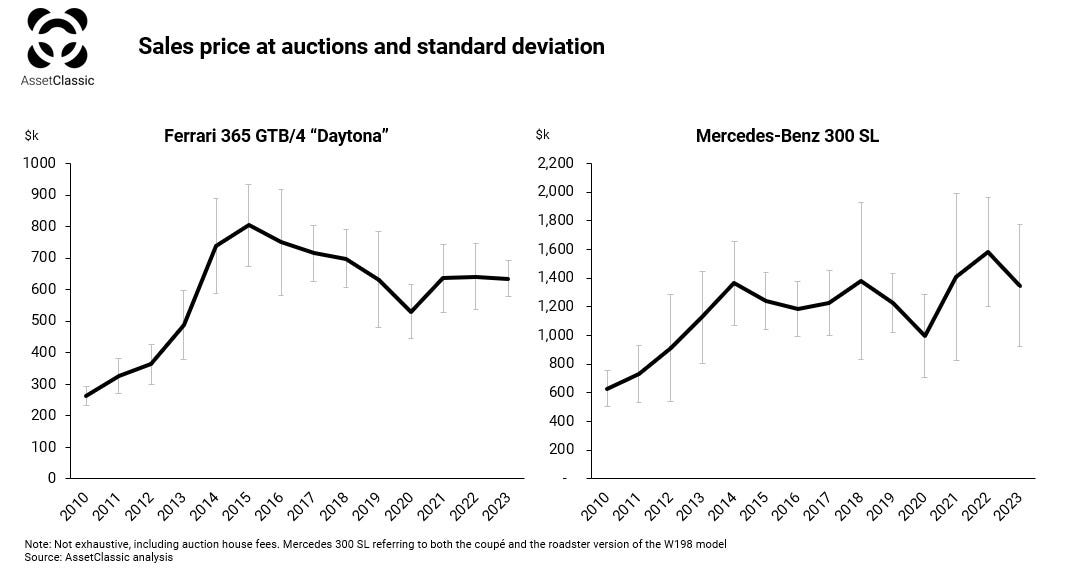
When building a car portfolio, it’s not just about valuing one vehicle correctly. To achieve repeatable performance, it’s required to consistently select the right assets. Easier said than done, since assets belonging to the same brand could have significant dispersion in valuation and performance, even across a single model. For example, the graphs below show the average auction price over the last 13 years for two of the most sought-after classic car models. Vehicles belonging to the same model and in the same condition can vary significantly in valuation depending on the configuration and history of the individual car: taking the example of the Ferrari 365 GTB/4 “Daytona”, there is an 18% mean standard deviation on the average prices over the years, which becomes a 27% when looking at the Mercedes-Benz 300 SL (we combined Gullwing and Roadster in this analysis). It is accordingly important to consider every factor involved in the selection of a vehicle, keeping in mind diversification within the portfolio.
Moreover, the classic car sector relies on numerous small specialized suppliers, often located in different areas. Knowing the right suppliers for jobs required and building trustworthy relationships is an excellent way of sourcing high-quality assets, preserving long-term value and ensuring that restorations add effective value. This is one of the core elements to make assets more attractive and valuable in the long-run. However, refurbishments are often a value-destroying proposition from an investment perspective, since their cost (and especially uncontrolled cost and time overruns) easily erode the initial benefit of purchasing a vehicle in non-perfect condition at an attractive price.
Investors and collectors have access to various solutions to overcome these challenges. To correctly ascertain the value of a vehicle, utilize all of the available public information which could be consulted to evaluate particular specs and gain useful insights (from valuation sources such as Hagerty to prior public auction results), as well as commissioned third party valuations, to have a clearer idea of the current market pricing based on the car’s condition. That said, selecting the right assets is also a matter of prediction on where the market is headed: data plays a decisive role when it comes to highlighting trends and market sentiment. Finally, successful restorations require a modern project management approach, time dedication and trusted sets of business professionals and classic car experts to formulate accurate estimates and avoid unexpected expenses. We pride ourselves in having developed the largest existing dataset on the collectible car market (AssetClassic Data), advanced analytics tools to interpret it, and a cutting edge project management software to oversee the renovations of the cars in our portfolio - more on that in the dedicated paragraph.
2. A wide network, built and nurtured over time, to establish trusted relationships
Despite being often underestimated, the power of networks in the classic car world is substantial. With such a number and variety of players involved across the value chain, it’s important to have connections and direct access to markets and suppliers. Securing a steady deal flow of potential opportunities is impossible relying solely on what is visible, considering that only about 20% of the assets are traded publicly and around half are listed publicly. An extensive network plays a pivotal role in enhancing transparency on potential buyers and bargains hidden from public knowledge.
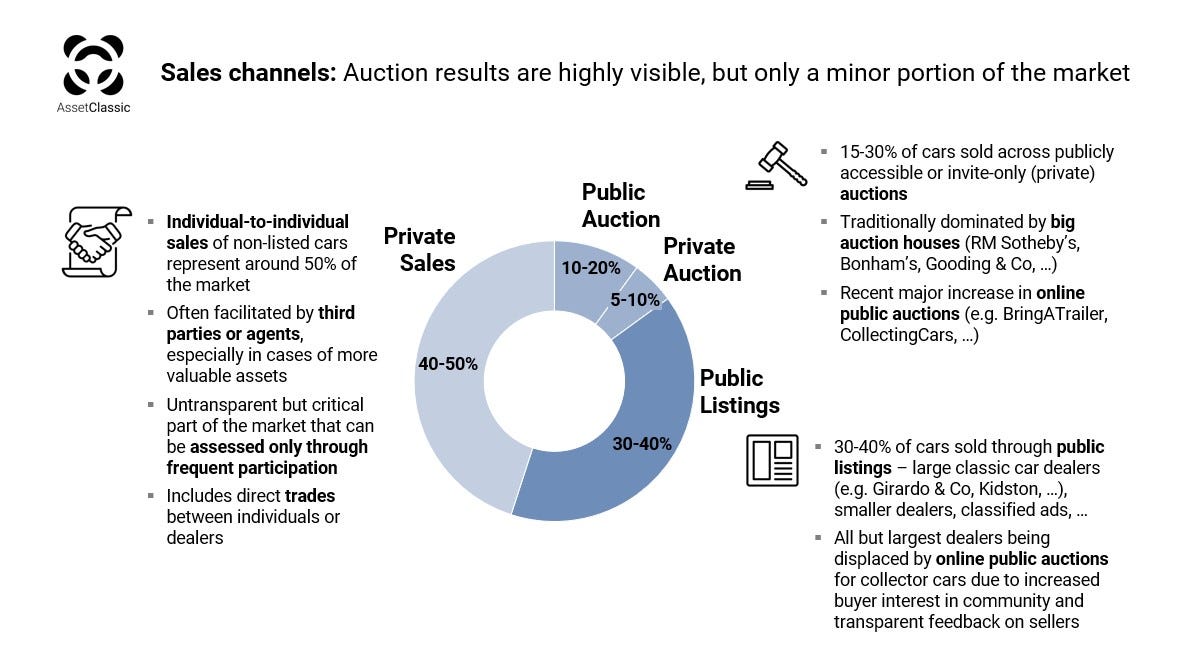
Another challenge is represented by the presence of ‘middlemen’, such as traditional auction houses, both in the buying and selling phases. While auctions provide a platform for high-profile sales and networking that may not be available elsewhere, it’s important to carefully evaluate associated costs. In order to maximize profits, exploring alternative channels and leveraging a wide network to directly engage with buyers makes a real difference in terms of value lost to brokers. In addition, especially when managing a portfolio of vehicles, it’s important to plan the divestment strategy for each asset ex-ante, with a clear path on adding value through sales defined before committing to a purchase.
On the other hand, keeping a stable presence on the market means building trust with sellers to help secure favorable deals and gain access to highly desirable off-market assets. Serious investors need to establish their reputation and credibility in the classic car community by continuously engaging with the market - attending and hosting events, participating in relevant fairs, and actively seeking connections within the classic car industry.
Building a strong and valuable network takes time and persistent effort. Investors need to operate diligently and transparently, establishing a presence in the markets of interest while exploring private channels, both on and off-line. This approach helps attract direct buyers and sellers and avoids often unnecessary value losses due to middlemen. Sellers represent a way of expanding the network exponentially: engaging in trusted relationships and keeping interactions well-alive, help both in sourcing and divesting, as well as in restoring classic cars.
3. Reaching the right scale to drive efficiency
Achieving efficiency through scale is a key factor when managing multi-asset portfolios. Vehicles, especially classic ones, require proper care, and optimizing running costs leads to higher returns. Scale enables minimizing maintenance, insurance, storage, and other costs connected with everything that revolves around a collectible car. By consolidating resources, it becomes easier to negotiate better terms for services, access favorable insurance rates, and optimize storage solutions.
Effectively marketing classic cars and leveraging events and social media to increase asset value through exposure demands dedicated resources. However, classic car investment is often pursued by individual enthusiasts or small-scale investment entities, making it challenging to allocate sufficient resources across these efforts. Investors need to carefully strategize their marketing initiatives and consider collaborations or partnerships to maximize exposure and attract potential buyers. Values of vehicles which participated in international and leading events, races and concourses, typically demand above-market prices as the public exposure serves as an additional quality confirmation.
Furthermore, given the high-ticket nature of many collectible cars, with individual assets often above the million-dollar mark, capitalizing on efficiency needs prudent allocation of resources and risk management, along with comprehensive financial planning and risk assessment to achieve the best in-class diversification without giving up big ticket investment opportunities.
Reaching scale is related, by definition, to larger collectors and professional investors. Achieving the same benefits without scale is difficult - potentially only replaceable by individual’s focus and overwhelming time commitment to negotiate the right deals, follow up on work being done and personally market the asset for sale. Nonetheless, diversification within the asset class can only be achieved one way.
The AssetClassic approach
As investors and long-term partners we have developed our own strategies to face these challenges and differentiate our position on the market.
As a player with the financial power to shape a large portfolio, we rely on historically-tested processes and tight internal governance to consistently select and evaluate assets. AssetClassic Data - the richest dataset in the collector car space - enables our decision-making with solid and concrete information, at both the micro and macro levels. By combining the power of data with passion and sector expertise, we are able to gather key elements for valuing a vehicle and identify emerging trends to target the right market niche. In addition, having developed a wide and trusted network of suppliers and artisans, we manage to add value through each step of the process, from sourcing to selling, and restoring when necessary.
We’ve been a market participant for years, refining the concept and enhancing the strategy. Our network is a strong differentiator, which allows us to reach valuable off-market opportunities as well as directly connect to buyers and sellers and cut down costs. Partnering up with important players in the classic car world further expands our reach and helps us to add value across the value chain, while shaping the ecosystem of which we are proud to be the center. Aon, Michelotto and Federperiti are only some of our partners, offering us market-leading conditions and expertise.
A well-shaped portfolio leads to scale and allows us to achieve efficiency. This results in a reduction of costs and enhanced better care for our vehicles. Generating value also means increasing the potential of our cars by participating in the leading international events. For example, we showed our Maserati 3500 GT to the public at The ICE in St. Moritz this February, and partnered with 1000 Miglia 2023 to celebrate classic cars through education and inclusiveness. On top of that, we adopt a strategic portfolio lens to each vehicle purchase in order to acquire assets of different values (some of which in need of restoration), knowing ex-ante the cash-flow related to every vehicle in our portfolio and having a clearly defined and differentiated exit strategy.
Despite some difficulties, which could be overcome with expertise, dedication and passion, collectible cars remain one of the best performing asset classes, and surely a unique opportunity both from the financial and experiential side.