When the movie star is a car: an analysis on the appreciation impact
While many vehicles are valued for their rarity and desirability, others acquire an additional layer of appeal the moment they appear in a movie. On-screen exposure can transform an otherwise ordinary model into an icon, though the scale of the so-called “movie premium” can vary widely.
James Bond and Steve McQueen’s cars show the extreme end of this phenomenon: in these cases, the film connection does not add value, it becomes the value.
The recent Bonhams Movie Cars Collection auction offered an additional opportunity to examine the same dynamic from a different angle: The catalogue brought together dozens of screen-used vehicles from Hollywood blockbusters, European comedies, cult classics, and television productions, with the important distinction that a large share of these cars is not intrinsically collectible. Looking at these cases makes it clear how a movie appearance alone can make a car desirable, even when it wouldn’t normally catch a collector’s eye.
Cultural Outliers and Emerging Icons
Some cars are so tied to movie culture that separating their automotive value from their screen presence becomes impossible. Models such as the Bullitt Mustang or Bond’s Aston Martin DB5s are valuable cars on their own, but the premium they achieve reflects how the market treats them more as myths than as traditional collectible cars.
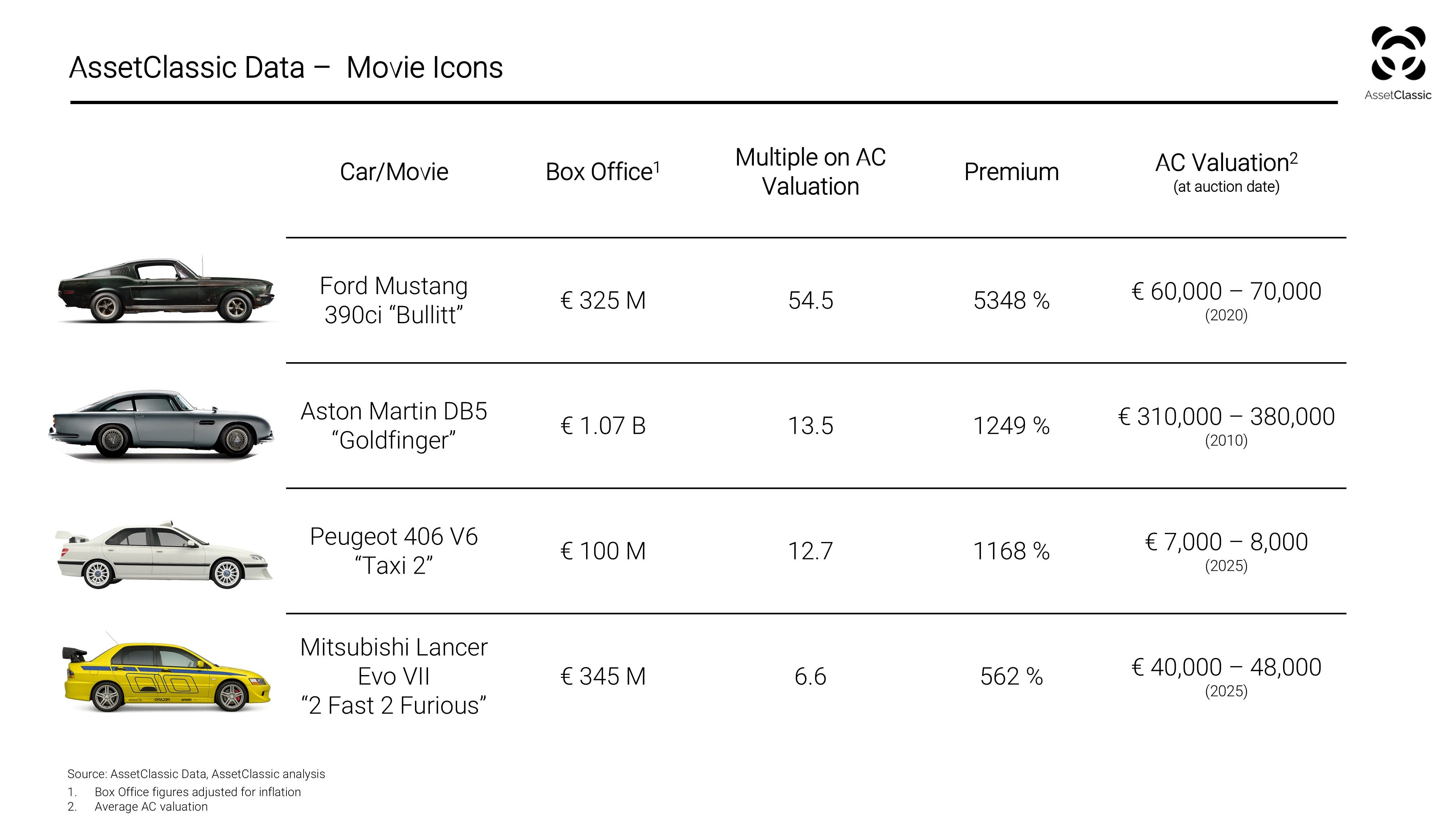
Bullitt (1968), for instance, became a defining moment for the Mustang brand. The movie grossed over €325 million adjusted for inflation, a substantial figure for its era, embedding the San Francisco chase scene not only in every petrolhead’s mind, but also into mass culture. This level of exposure transformed the “hero” car from the movie into an icon. The market reflected this: the original Bullitt Mustang sold for over €3.2 million, roughly 54x the value of a comparable 1968 GT 390.
A similar logic applies to the Aston Martin DB5. The James Bond franchise spans more than six decades and has generated over $7 billion in cumulative worldwide box office results. Across multiple Bond films, the DB5 is repeatedly framed as an extension of the character himself: gadgets, driving sequences, and narrative importance transformed the model into a permanent symbol of the franchise. Unsurprisingly, one of the original “Goldfinger” DB5s achieved a multiple of 13.5x of its base-car value, showing how the car is perceived more as a cultural reference point than just an automobile.
The Bonhams auction included two cars that exhibit the same dynamic on a smaller, more contained scale. The Peugeot 406 V6 from Taxi 2 is a prime example. The Taxi franchise was one of the most commercially successful European film series of its era, with the first two films together attracting over 20 million cinema-goers in Europe. This car illustrates how regional cultural imprint can generate a significant premium even in the absence of intrinsic collectability. The 406 is visually dominant, repeatedly used in action sequences, and inseparable from the film’s identity in its core markets. This resulted in a €95,200 hammer price, approximately 12.7× its base-car value of €7,000–8,000.
Another example of a semi-icon at the Bonhams Movie Cars auction is the Mitsubishi Lancer EVO VII from 2 Fast 2 Furious, which achieved €291,200, roughly 6.6× its base value, which typically ranges between €40,000 and 48.000. This result follows the same pattern of the Toyota Supra MkIV from The Fast and the Furious (2001), which achieved a multiple of around 4.7× when it appeared at the 2021 Barrett-Jackson auction. In both cases, the models are tightly associated with Paul Walker, repeated driving sequences, and the early phase of the series, when the films were still conceived primarily as movies about cars rather than action films with cars.
The strength of this association becomes even clearer when looking at the Mazda RX-7 Veilside from Tokyo Drift, which sold for around €1 million at the 2025 Goodwood Festival of Speed auction by Bonhams, roughly 26× its base value. While more visually distinctive, the result points to the same conclusion: supported by a franchise that has generated over $7 billion in worldwide box office, even cars that would not normally be considered collectible can achieve very strong premiums. The relatively young age of the franchise, together with the cars in question, also points to the growing buying power of newer generations of collectors and their increasing relevance within the collector car market.
These multiples, of course are helped by the relatively ordinary nature of these cars, so a strong cultural association can produce very large multiples when starting from a low base, as seen with models like the 406 V6 and the Lancer EVO VII.
It is clear that once a car reaches this level of cultural recognition, traditional valuation logic is no longer applicable. These premiums are economic expressions of iconic status.
Why the Bonhams Dataset Matters
Removing these cultural outliers reveals why this auction is particularly and unusually insightful.
In fact, by granting extraordinary visibility to what could be considered ordinary vehicles, it allows the movie premium to be observed with far less distortion, since the cars’ desirability still depends, at least in part, on the underlying model.
This makes the Bonhams selection uniquely suited to address another question.
How do different types of movie association affect value, and to what extent?
To answer this, the analysis relies on two complementary comparisons, each testing a different aspect of the “movie” value equation.
Main actor or support?
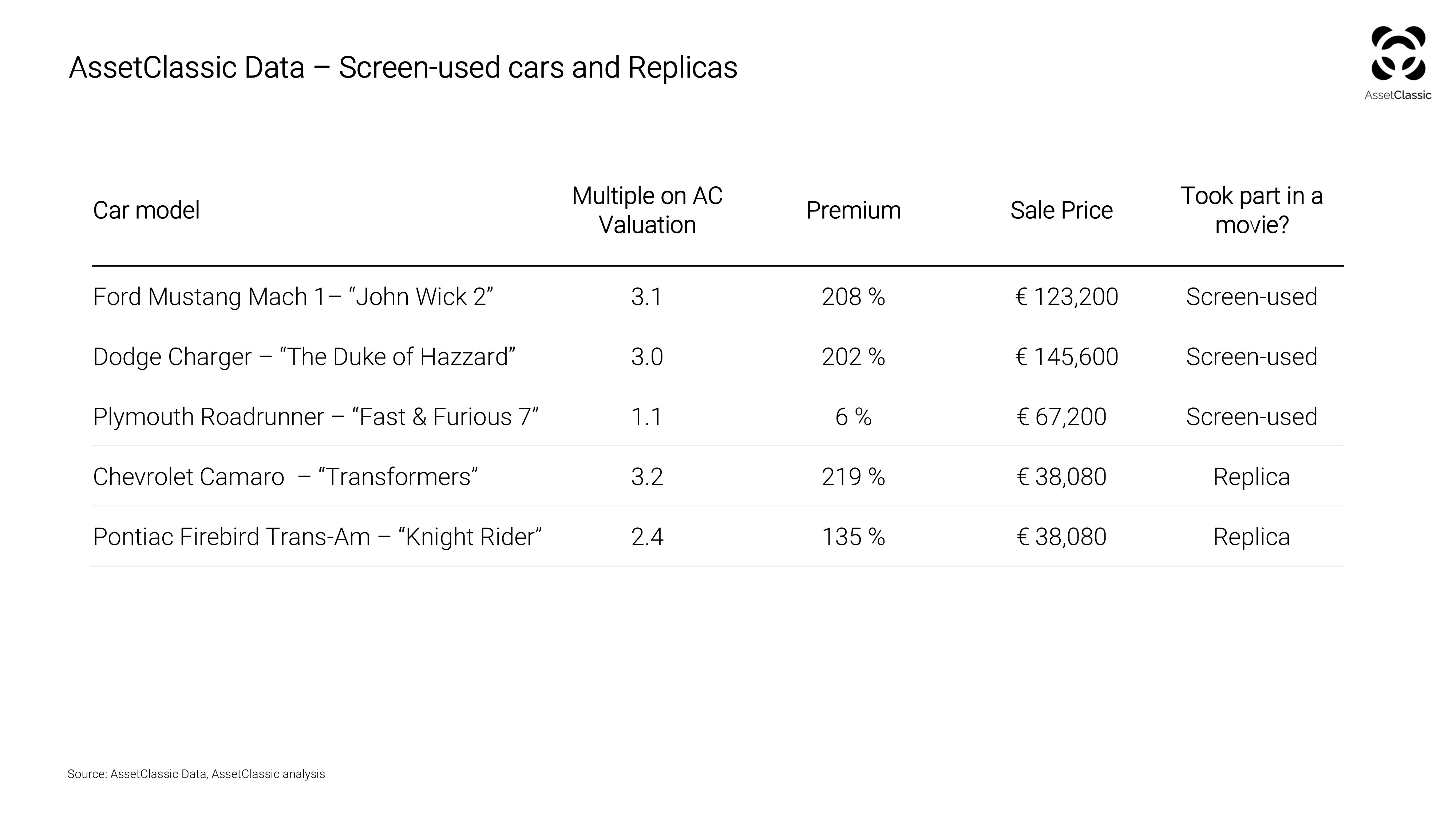
Valuation is clearly not only impacted by being in a movie, but also how relevant the car’s part is within it. An example from the Bonhams auction?. The Ford Mustang Mach 1 from John Wick sold for roughly 3.1× its base car value, as did the General Lee Dodge Charger, which achieved a near-identical multiple. In both cases, recognisability and franchise strength translated directly into market performance.
Other vehicles with less relevant roles, however, remained close to baseline valuations. For example, the Plymouth Road Runner that merely appeared in Fast & Furious reached only 1.1× its average base-car value, indicating that mere appearance is not sufficient to generate a meaningful premium, especially considering the rough lives often lived on set by “hero” cars - offsetting in a collector’s view the glamour of its cinema appearance.
The pattern is clear: a strong cinematic identity produces strong premiums. Where narrative relevance is limited, the uplift diminishes accordingly.
Replicas vs Base-Car Values
Replicas occupy a middle ground: they are often in better mechanical and cosmetic condition than screen-used cars, but they lack historical provenance. Their value comes from visual impact and emotional connection rather than authenticity.
Many replicas are built as no-expense-spared projects and often become financial sinkholes, with build costs that far exceed the value of the base car. However, the Bonhams auction showed that replicas can still have a real market, especially when exposure and recognisability are high.
A Bumblebee Chevrolet Camaro replica achieved 3.2× its base value, while a Knight Rider Pontiac Firebird replica reached 2.4×. In both cases, cinematic association alone was enough to lift values beyond what the underlying models would normally command.
Replicas therefore attract buyers less as historical artefacts and more as emotionally charged objects, positioned between memorabilia and cars. Well-executed replicas do have their own market.