


The collectible classic car market began 2025 with stability, as the AssetClassic Auction Index (ACAI) posted a modest gain of +1.4% in Q1 2025. Following a year marked by correction and volatility, this performance suggests that the market may be entering a more stable phase – should macroeconomic factors support it.
While underlying trends point to growing interest in younger classics, especially from the 1990s and 2000s, the top end of the market continues to be firmly dominated by classics from the “golden eras.” The standout sale of the quarter, a 1954 Mercedes-Benz W196R Streamliner F1 that achieved $53.9 million, reaffirmed that rare vehicles with historical significance remain unmatched in collector value. Indeed, most of the top ten sales in Q1 were of cars from the 1970s or earlier, underscoring that timeless provenance continues to set the standard in the ultra-high-end segment.
Meanwhile, market dynamics showed nuanced shifts. Gains in the ACAI were primarily driven by the strength of 1990s models (+9.2%), while earlier segments such as the 1970s and 1980s posted more moderate growth. Vehicles from the pre-1960s era, though still under pressure, showed signs of stabilization.
On the regulatory front, newly announced U.S. import tariffs had limited direct impact on the classic segment, as vehicles older than 25 years remain exempt. Importantly, Q1 concluded just as the new measures took effect, meaning any market consequences are yet to materialize. For now, auction activity and pricing remain unaffected, and sentiment among collectors remains cautiously optimistic that the segment will stay resilient in the face of broader trade shifts. Moreover, rising tariffs on new luxury vehicles may encourage some buyers to shift toward classic cars as more appealing and cost-efficient alternatives. This behavioral shift could boost interest in collectibles, especially those exempt from new duties. However, macroeconomic uncertainty may still temper short-term buyer enthusiasm, keeping overall market resilience in check as 2025 unfolds. We will watch the next several auctions closely to see any signs of weakness.
1. Classic and collectible car values
The AssetClassic Auction Index (ACAI) includes classic and collector vehicles made before 2010s, with a focus on those with average values higher than EUR20,000. While the data goes back to the 1970s, the index starts in Jan 2002 at 100. The ACAI is updated monthly and based solely on auction results, with no manual adjustments.
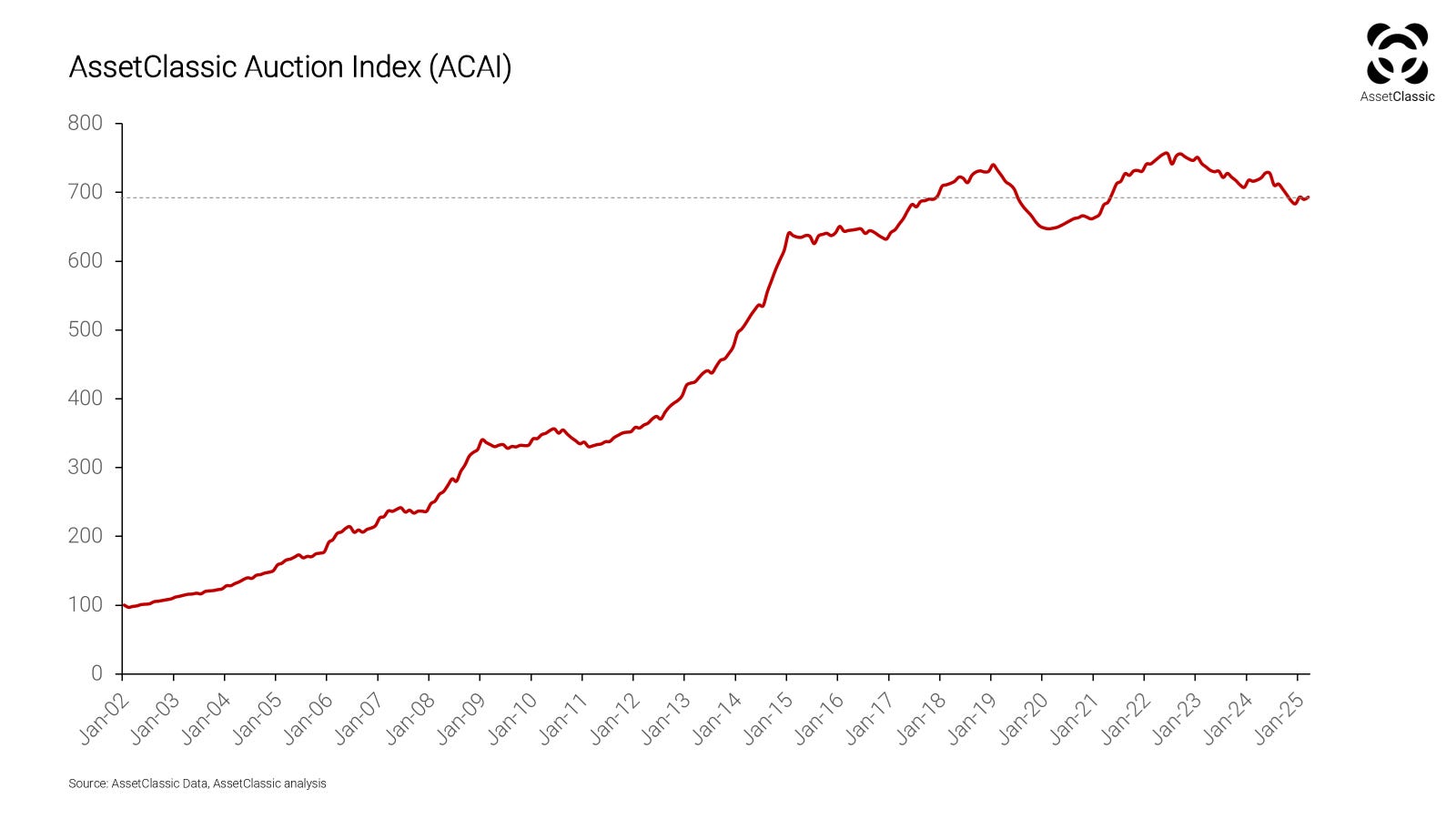
In the first quarter of 2025, the AssetClassic Auction Index (ACAI) continued the stabilizing trend observed in late 2024, reflecting a market navigating post-correction dynamics. After the approximate 3-4% decline over the course of 2024, the ACAI entered the new year with a modest yet notable sign of resilience. Since December 2024, the index hovered around the 700 mark, showing a slight dip early in the quarter, followed by a mild recovery toward the end of March, ultimately increasing by 1.4% for the quarter.
The absence of strong fluctuations in Q1 2025 contrasts with the more volatile quarters of 2024, particularly the third quarter, which recorded one of the weakest Q3 performances in recent history. While market momentum remains subdued compared to the highs of 2022 and early 2023, the ACAI’s current performance hints at a potential plateau rather than a continued downward trajectory.
Should macroeconomic conditions stabilize and key auctions deliver solid performances in Q2, the classic car market may well enter a new phase of gradual recovery and recalibration.
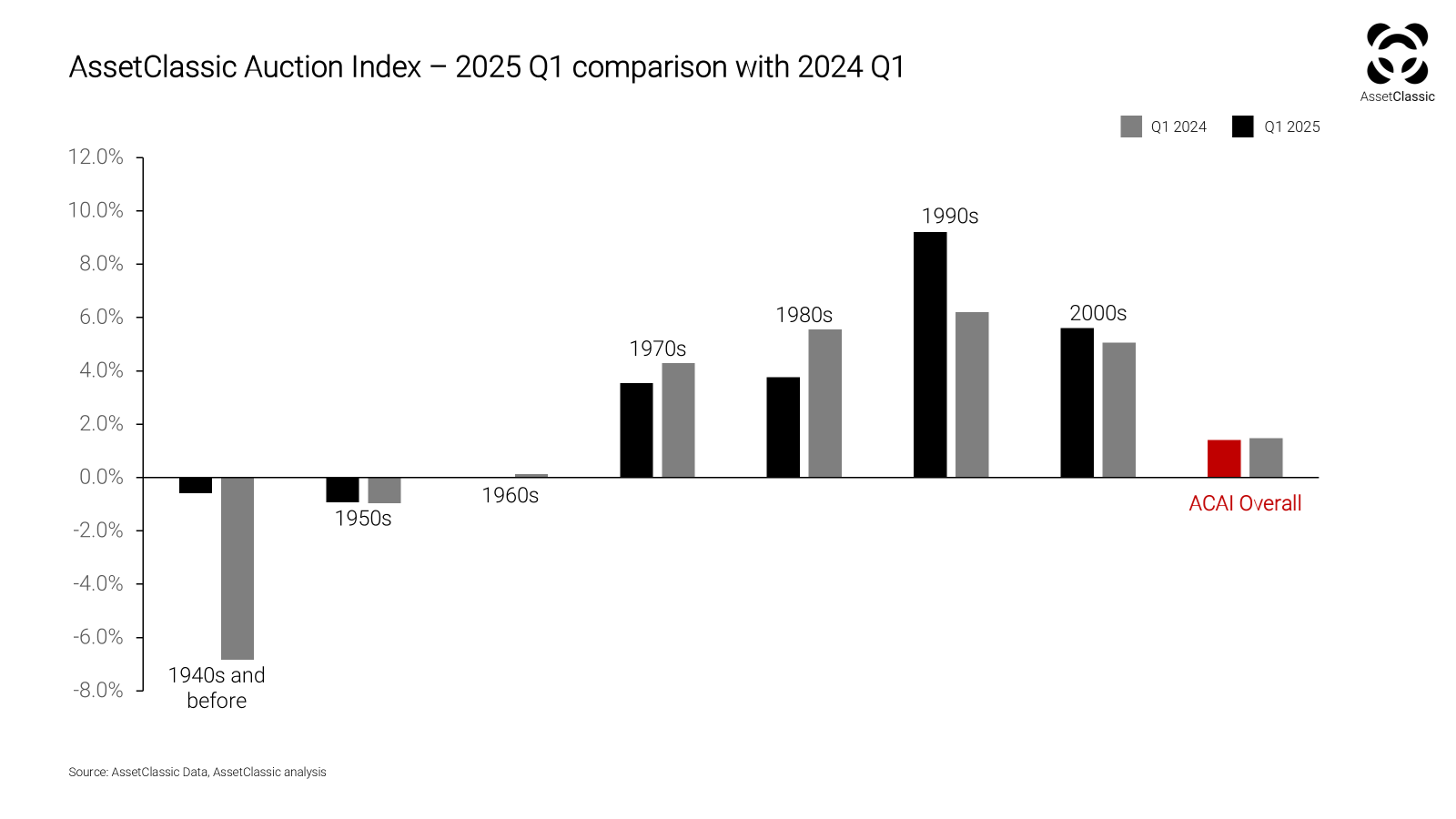
The first quarter of 2025 saw the AssetClassic Auction Index (ACAI) post a modest gain of +1.4%, nearly identical to the +1.5% recorded in Q1 2024. Despite this apparent stability in the headline figure, the decade-level breakdown reveals slight differences. In Q1 2024, gains were largely driven by the strength of modern classics, particularly cars from the 2000s (+5.1%) and 1990s (+6.2%), with healthy contributions from the 1980s (+5.6%) and 1970s (+4.3%).
In contrast, 2025 saw a redistribution of momentum. The 1990s stood out with a sharp rise to +9.2%, confirming their status as one of the most in-demand segments, likely driven by growing enthusiasm for analogue supercars and emerging collector interest from younger generations. Vehicles from the 2000s also improved slightly to +5.6%, consolidating their appeal, while the 1980s slowed, falling from +5.6% to +3.8%. The 1970s segment followed a similar trend, slipping from +4.3% to +3.5%. More surprising is the continued underperformance of earlier vehicles, although with signs of stabilization. Cars from the 1940s and before, which suffered a sharp -6.8% decline in Q1 2024, recovered slightly to -0.6% in Q1 2025. Similarly, 1950s models softened their drop from -1.0% to -0.9%. Although still negative, these figures indicate a slower rate of decline and a potential stabilization. The 1960s, meanwhile, remained flat in Q1 2025 (0.0%) after a light +0.1% in Q1 2024.
In essence, while the overall ACAI figure remained virtually unchanged year-on-year, the underlying market dynamics have evolved. 2024's Q1 growth was more broadly distributed across multiple decades, whereas 2025 Q1 has been increasingly driven by the strength of 1990s vehicles, supported by stability in the 2000s and modest resilience in other post-1970s segments. Simultaneously, the deceleration of losses in older vehicles hints at a potential rebalancing within the market.
2. Top 10 public auction sales in Q1 2025
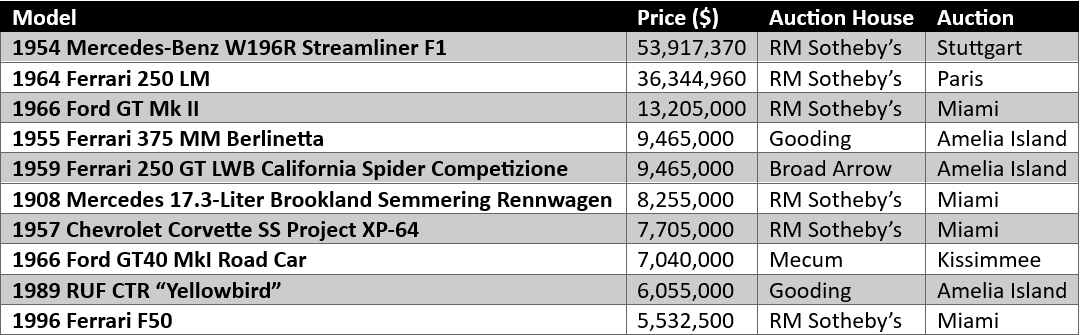
The top 10 auction sales of Q1 2025 continue to reinforce a key observation: while the buzz around youngtimers and modern hypercars grows louder, it is the timeless allure of historic classics that still commands the highest premiums. Topping the list, and setting the tone for the quarter, is the 1954 Mercedes-Benz W196R Streamliner F1, which achieved $53.9 million at RM Sotheby’s Stuttgart, reaffirming its status as one of the most significant Grand Prix cars ever built.
This year’s top sellers are mainly composed of pre-1970 icons, highlighting the continued dominance of historic relevance, rarity, and provenance in the ultra-high-end segment. The message is clear: collectors are still willing to pay a premium for irreplaceable legends born from motorsport or hand-built icons. Notably, seven out of the ten top sales are from the 1950s or earlier, including the 1908 Mercedes racer. Even the 1957 Chevrolet Corvette SS Project XP-64, though an outlier in terms of brand, achieved $7.7 million, reflecting its rare prototype status.
While modern vehicles made a marginal appearance, with the 1989 RUF CTR “Yellowbird” ($6.05M) and the 1996 Ferrari F50 ($5.53M), they were the exception rather than the rule. These two sales, though highly respected and increasingly collectible, still trail significantly behind in price, confirming the enduring hierarchy in the market. Their inclusion does, however, suggest that the floor of elite car collecting is gradually expanding to include landmark vehicles from the 1980s and 1990s—particularly those with cultural or performance-related significance.
3. Regulatory developments
The introduction of new U.S. tariffs on imported vehicles and automotive parts in late March 2025 raised immediate concerns across the global automotive sector, especially regarding their potential ripple effects on the collector car market. The new measures essentially impose a 25% tariff on most imported cars and select components. However, crucially for collectors, vehicles older than 25 years remain exempt from the tariff and continue to be subject only to the standard 2.5% import duty. As such, the direct impact on the classic and collectible car segment appears, at least initially, to be limited.
That said, the broader implications are still unfolding. The increased cost of parts, many of which are shared across both modern and older vehicles, could indirectly affect maintenance and restoration costs for certain classic models, particularly those dependent on overseas suppliers. Moreover, the evolving nature of tariff policies in recent years has injected a layer of uncertainty into the market. The frequent adjustments and recalibrations of tariff rates have created a macroeconomic environment of unpredictability. For collectors, dealers, and investors in classic cars, this volatility complicates long-term planning and financial forecasting, as tariff changes can significantly alter the cost dynamics of acquiring and maintaining vehicles. The classic car market, by its very nature, thrives on stable economic conditions, and the frequent shifting of tariff structures only adds to uncertainty. These tariff changes are making it harder to predict how the costs of restoring classic cars will evolve, especially for vehicles that are already expensive to import. As a result, dealerships, investors, traders, collectors, and restoration shops may be hesitant to make large-scale purchases or commitments until they can gauge the true impact of these tariffs.
A more immediate and tangible effect of the new tariffs is likely to be felt in the US classic car restoration industry. Restoration is an intricate process that relies heavily on imported parts, from mechanical components like engines and transmissions to rare body panels and trim pieces. These parts are essential to maintaining the originality and quality of restored vehicles, and with the 25% tariff now applied to many imported car parts, restoration costs are set to rise significantly. For restoration shops, which are already navigating higher labor costs and supply chain challenges, the added cost of imported parts may force them to increase their prices, potentially deterring customers from pursuing restoration projects. Smaller shops that rely on specific foreign parts could be disproportionately affected, with some possibly having to adjust their business models or focus on more commonly available parts. Moreover, the impact of tariffs on parts could lead to longer restoration timelines as shops struggle to source the necessary components. Delays in the import process, combined with rising prices, could frustrate clients and reduce the overall demand for restoration services, particularly among hobbyists and entry-level collectors. As a result, the restoration market may become less accessible to a broader audience, with only high-end restoration projects remaining viable. This could shift the focus of the classic car market, concentrating more on high-value, well-established models rather than less common or more affordable classics.
Beyond restoration and import dynamics, it’s worth noting a potential behavioral shift that could work in favor of the classic car market. As tariffs and duties increase the cost of importing new high-end luxury vehicles, particularly from Europe and Asia, some buyers may increasingly turn to classic cars as an alternative for recreational driving, investment, or status expression. In this light, collectible vehicles, especially those exempt from the new import duties, could benefit from a renewed appeal as both emotionally engaging assets and relatively cost-stable alternatives to heavily taxed modern exotics. However, this upside is tempered by the broader context of macroeconomic uncertainty. Fluctuating trade policies and a cautious global outlook may restrain short-term purchasing enthusiasm, especially among discretionary buyers. Even in the high-end segments of the market, some collectors may delay acquisitions or focus more on preserving existing assets rather than actively pursuing new purchases.
All things considered, while the broader market impact of the tariffs on classic cars seems minimal for now, the restoration segment is more likely to feel the pressure. As the global automotive supply chain continues to adjust to these tariffs, restoration costs could rise, timelines may stretch, and some shops may face financial strain, ultimately affecting both the cost and availability of restoration services. This uncertainty, combined with fluctuating tariffs, creates a situation where the market must navigate evolving trade barriers, potentially altering the dynamics of the classic car industry in ways that are still unclear.
In general, Q1 2025 opened with signs of renewed stability and shifting momentum across segments. As always, we look forward to seeing how the year unfolds, and to continuing to contribute, in our own way, to a passionate and evolving collector community.